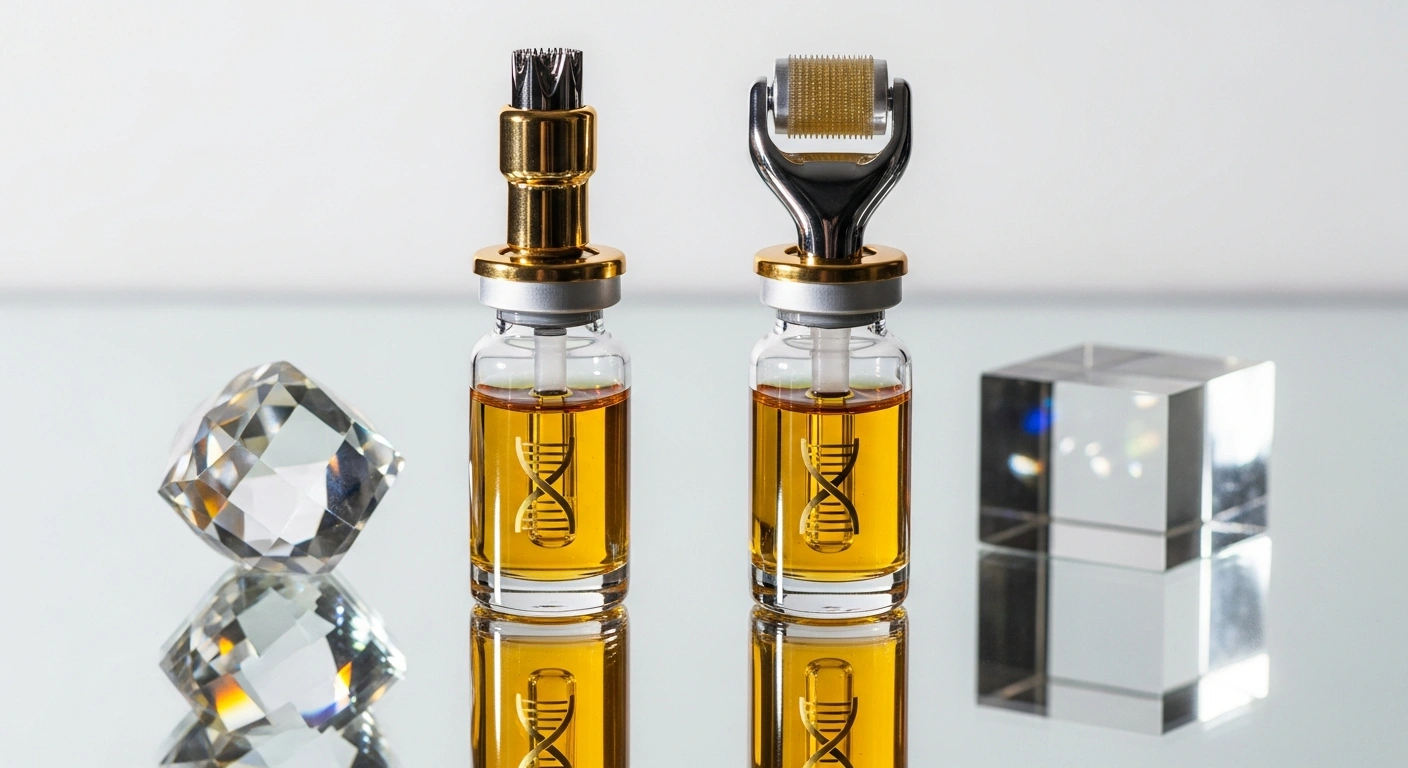
Walk into any beauty store or scroll through skincare content, and you’ll see these terms used interchangeably: microneedling, derma rolling, skin needling. But they’re not quite the same thing, and understanding the difference can save you from subpar results—or worse, damaged skin.
The Basic Difference
Both techniques use tiny needles to create micro-channels in your skin. The difference is in how those needles enter and exit.
Derma rollers are cylindrical drums covered in needles. You roll them across your skin, and the needles enter at an angle, travel through the skin, then exit at another angle.
Microneedling stamps (or pens) press needles straight down into the skin, then pull straight back out. The entry and exit point are the same.
This might seem like a minor distinction, but it significantly impacts your results and skin safety.
| Feature | Derma Roller | Microneedling Stamp |
|---|---|---|
| Needle entry angle | Angled | Perpendicular (straight down) |
| Risk of micro-tears | Higher | Lower |
| Consistency of channels | Variable | Uniform |
| Ease of use | Requires technique | Simpler stamping motion |
| Best for | Very superficial treatments | All treatment depths |
Why the Technique Matters
The Problem with Rolling
When a derma roller needle enters your skin at an angle and exits at another angle, it creates more of a scratch than a clean puncture. This can cause micro-tears—tiny rips in the skin that aren’t part of the intended treatment.
Micro-tears trigger inflammation without the controlled healing response you want. They can also increase the risk of scarring, especially if you’re using longer needles or applying too much pressure.
The Advantage of Stamping
A microneedling stamp creates clean, vertical channels. Needles go straight in, straight out. Your skin responds with a controlled healing cascade—exactly what we want for collagen stimulation and better product absorption.
Which Is Safer for Home Use?
For at-home microneedling, stamps are generally the safer choice. Here’s why:
Less technique-dependent. With a roller, you need to control pressure, speed, and angle consistently across your entire face. With a stamp, you just press and lift.
Better for contoured areas. Try rolling smoothly around your nose or eye area. It’s awkward. Stamps can precisely target any facial contour.
Single-use heads. Most quality microneedling stamps use disposable needle heads. Many derma rollers are designed to be reused, which creates hygiene concerns even with cleaning.
What About Results?
Both methods can improve skin texture, boost product absorption, and stimulate some collagen production. However, microneedling stamps typically deliver more consistent results because the channels are uniform, healing is more predictable, you can treat specific areas more precisely, and there’s less collateral irritation.
Several studies have shown that vertical needling (stamping) triggers a stronger collagen response than angled needling (rolling) at the same depth.
The Needle Quality Factor
Beyond the rolling vs. stamping debate, needle quality matters enormously.
Cheap derma rollers often have needles that are poorly attached, inconsistently sized, or made from lower-grade materials. They dull quickly and can cause more trauma than intended.
Quality microneedling kits use precision-manufactured, sterile needle heads that maintain their sharpness throughout a single treatment and are then discarded.
When Derma Rollers Make Sense
I’m not saying derma rollers are useless. They can work well for very gentle, superficial treatments—think 0.25mm or less, a few times a week, mainly for product absorption rather than collagen stimulation.
If you already own a quality derma roller and it’s working for you, there’s no need to switch. Just be aware of its limitations and don’t push into deeper needle depths.
My Recommendation
If you’re starting fresh or looking to upgrade your at-home microneedling routine, go with a stamp-style kit. The results are more consistent, the technique is easier, and you’ll avoid the micro-tear issue entirely.
The GlowYoung kit uses a stamping mechanism with sterile, single-use needle heads—exactly what you want for safe, effective home treatments.
Next, learn about choosing the right needle depth for your goals and which serums to use for maximum results.


